TL;DR Click a bookmark → paste four numbers → instantly know whether two conversion rates are meaningfully different.
No tools. No spreadsheets. No dashboards. Just your browser.
Why? Have you ever been in a meeting, a Slack thread, or staring at an A/B test dashboard and thought:
“2.3% vs. 2.7% — is that actually meaningful, or just noise?”
Well then this bookmarklet is for you! Other recipients include but are not limited to…
Update, 2023-04-05: By popular demand, I updated the below solution to include a second function which stores the screenshots in a subfolder.
The Final Result Let me start this article by showing you my usage of the functionality described. I work as a Data Scientist and use org-mode in Emacs for a large number of every day tasks. One of them is the documentation of new findings within datasets or other software's documentation or websites etc.

Eager to Play TicTacToe? The package neckar contains a fully functional reinformcement learning model to train yourself and play against in the game TicTacToe. Here’s how you can simply download and install the result if you have a gitlab account (and can set up a personal access token…):
pip install neckar --extra-index-url https://__token__:personalaccesstoken@gitlab.com/api/v4/projects/37714906/packages/pypi/simple … and if you don’t: Download the wheel from this link, cd to the wheel and run
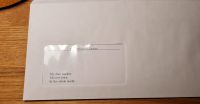
TL;DR This post explains how to set up emacs so that the writing and sending of letters is always just a whim away. The resulting letters will adhere to the German DIN 5008 standard, and fit neatly into envelopes designed on that standard, as shown in the cover image on the top.
Prerequisites All you for the implementation shown in this tutorial is
Emacs with org-mode and a LaTeX installation with the dinbrief.
<img src="https://vg09.met.vgwort.de/na/b66f5b9419e744cb911470ba098ba870" width="1" height="1" alt="">
The Final Result Let me start this article by showing you the final result of this article. Below you see a screengrab of me checking the new mails I received today, from across 3 separate mail accounts (including a gmail account) deleting two mails on the fly, while skimming the remaining two searching through all my mails for the keywords "thalia AND FIFA" and finding the result immediately <video width= "960" height="720" controls> <source src="https://res.
A Standard Problem: Determining Sample Size Recently, I was tasked with a straightforward question: "In an A/B test setting, how many samples do I have to collect in order to obtain significant results?" As ususal in statistics, the answer is not quite as straightforward as the question, and it depends quite a bit on the framework. In this case, the A/B test was supposed to test whether the effect of a treatment on the success rate p had the assumed size e.
The Setting: Avoiding 4 Weeks of Runtime Recently, I was faced with a problem: I had written a rather complex simulation of a discrete time queueing network, and I needed to let this simulation run
with some repetitions of the entire simulation, for some varying different parameter values, with many observations (i.e. ~ 2.000.000 observation). The goal was to verify that a new estimating procedure for such queueing networks provides sensible results.